Monday, November 25, 2019

ST. JOSEPH, PATERNAL RIGHTS, & POPE BENEDICT XV


The current millennium seems to be open to St. Joseph, the Guardian of the Redeemer, who up until recently was hidden, in a way. The faithful are discovering his role not only within the pious walls of the Church, but also in their daily lives. Why is this important? Why does one need Joseph? 

Joseph has emerged at this critical time in history because now more than ever a human father is needed, a noble model of manhood for these troublesome times, as there is a war currently being waged on manhood.

Fathers, or “breeders” (as some people dare to label heterosexual men, quite derogatorily,) are shamed from exercising any rights over their children. It is the children who are encouraged to make their own decisions, even those of an extremely serious, adult nature (or unnatural nature), such as the now popular theme of changing sexes. The “breeders” no longer have a say in what is best for their children. Their sole purpose is to bring the child into the world and be as accommodating as possible to their whims and ideas – regardless of health, safety, or salvific risks.

There is a shaming of parenthood when one tries to make important decisions for children, when one tries to discipline them, or even in giving them spiritual formation. The common phrase from parents these days is “I’ll let my child decide what they want”. Fathers no longer have the rights accorded to him by God as they have been taken away by the world. God is no longer the judge of humanity but, rather, the ungodly public is.The shaming of fatherhood must stop!!

Pope Benedict XV warned us about this sort of thing one hundred years ago! And who did the Pontiff give the faithful as a model and protector for those evil times? St. Joseph. How much more do we need him now, in this diabolical 21st century. The Pope’s words are so in tune with our present state that he could easily have uttered them this morning:

"We now see, with true sorrow, that society is now much more depraved and corrupt than before, … This World Government will no longer acknowledge the authority of the father over his children, or of the public power over the citizens, or of God over human society. We, therefore, concerned most of all by the course of these events … recommend the faithful to St. Joseph, to follow him as their guide and to receive the special honour of his heavenly patronage (Benedict XV, 1920)."


Wednesday, November 13, 2019

THE PRAISES OF ST. JOSEPH


Hail Joseph, image of God the Father.
Hail Joseph, father of God the Son.
Hail Joseph, temple of the Holy Ghost.
Hail Joseph, beloved of the Holy Trinity.
Hail Joseph, most faithful helper in the great plan of Redemption.

Hail Joseph, most worthy spouse of the Virgin Mother.
Hail Joseph, father of all the faithful.
Hail Joseph, guardian of holy virgins.
Hail Joseph, greatest lover of poverty.
Hail Joseph, example of meekness and patience.
Hail Joseph, mirror of humility and obedience.

Blessed art thou among all men.
And blessed are thine eyes,
which have seen what thou hast seen.

And blessed are thine ears,
which have heard what thou hast heard.

And blessed are thy hands,
which have touched the Word Incarnate.

And blessed are thine arms,
which have carried the One Who carries all things.

And blessed is thy breast,
on which the Son of God most sweetly reposed.

And blessed is thy heart,
kindled with most ardent love.

And blessed be the Eternal Father, Who chose thee.
And blessed be the Son, Who loved thee.
And blessed be the Holy Ghost, Who sanctified thee.
And blessed be Mary, thy spouse,
who loved thee as a spouse and a brother.

And blessed be the Angel, who guarded thee.
And blessed be forever all who bless thee and who love thee.


Tuesday, November 5, 2019

St. Joseph the Old Widower?


Was St. Joseph an old widower by the time he was espoused to the Blessed Virgin Mary? This idea is popular in the Eastern Rites as they once drew heavily from the apocryphal books not contained in the Bible. 

According to the saints and mystics of the Catholic Church, Joseph is said to have been no older than 33 years of age when he was espoused to Mary, however through the ages European art has depicted Joseph as an elderly man hunched over his walking stick, or, more commonly in Orthodox Nativity icons, as an old man sitting on the ground away from the Virgin Mary and newborn Jesus. In true Orthodox icons St. Joseph is always depicted as being elderly and is never to be holding the Child Jesus or touching the Virgin Mary. He is merely an observer.


The reason for the “elderly Joseph” portrayal was to protect the doctrine of the perpetual virginity of Mary by finding an explanation for the brothers and sisters of the Lord, such as those mentioned in Matthew 12:46. The apocryphal book known as The Proto-Evangelium of James, which was condemned by Pope Innocent I, was the answer to this dilemma, and states that Joseph was an elderly widower with four sons and two daughters by the time he met Our Lady and married her when he was 78 years old. However, the saints and mystics of the Catholic Church agree that Joseph had no wife but Mary.

Focusing on the physical, and not the spiritual, people could not envision this marriage as being without sexual intimacy unless there was some sort of physical barrier, such as the husband being too old to perform sexually.

As St.Josemaria Escrivá tells us, St. Joseph’s youth and strength were not obstacles to the virginal love he had for Mary:
“I don't agree with the traditional image of St. Joseph as an old man, even though it may have been prompted by a desire to emphasize the perpetual virginity of Mary. I see him as a strong young man … in the prime of his life and work. You don't have to wait to be old or lifeless to practice the virtue of chastity. Purity comes from love; and the strength of youth is no obstacle for noble love. Joseph had a young heart and a young body when he married Our Lady. Anyone who cannot understand a love like that knows very little of the Christian meaning of chastity - St. Josemaria Escrivá, founder of Opus Dei.

We now turn to St. Jerome, Doctor of the Church, who explains the virginal relationship between Joseph and Mary:

That God was born of a virgin we believe because we read it in the Holy Bible.  That Mary consummated marriage after her childbirth we do not believe because we do not read it.  Nor do we say this to condemn marriage, for virginity is itself a fruit of marriage, but because there is no license to draw rash conclusions about holy men. For if we wish to take the mere possibility into consideration, we can contend that Joseph had several wives because Abraham and Jacob had several wives and that from these wives, the ‘brethren of the Lord’ were born, a fiction which most people invent with not so much pious as presumptuous audacity! You say that Mary did not remain a virgin; even more do I claim that Joseph was virginal through Mary, in order that from a virginal marriage a virginal son might be born. For if the charge of fornication does not fall on this holy man, and if it is not written in the Bible that he had another wife, and if he was more of a protector than a husband of Mary, whom he was thought to have as his wife, it remains to assert that he who merited to be called the father of the Lord remained virginal with her (P. Schaff & H. Wace, 2007, pg. 344).

From the earliest days of the Church, the faithful believed in the perpetual virginity of the mother of Jesus. Also, Church traditions fully support that Joseph, being led by the Holy Spirit, chose to offer everything about himself to God and had made a vow of virginity early on in life. Given that he was sanctified by God and given many special graces, this doesn’t seem so strange. Venerable Maria de Agreda, Mother Cecelia Baij, St. Francis de Sales and St. John Paul II speak of the virtue of Joseph’s virginity:

Maria de Agreda writes: Joseph had made and kept the vow of chastity … and was known for the utmost purity of his life, holy and irreprehensible in the eyes of God and of men. (M. Agreda, 1912, p. 576).  

Madre Cecelia Baij: As he made his promise of perpetual virginity to God, Joseph’s heart was filled with an inexpressible joy (C. Baij, 1997, pg. 54).

St. Francis de Sales: How exalted in this virtue of virginity must Joseph have been who was destined by the Eternal Father to be the companion in virginity of Mary! Both had made a vow to preserve virginity for their entire lives, and it was the Will of God to join them in the bond of a holy marriage (E. Thompson, 1953, pg. 90).

And finally, St. John Paul II: In the Liturgy, Mary is celebrated as "united to Joseph, the just man, by a bond of marital and virginal love.” There are two kinds of love here, both of which together represent the mystery of the Church - virgin and spouse - as symbolized in the marriage of Mary and Joseph. Virginity or celibacy for the sake of the Kingdom of God not only does not contradict the dignity of marriage but presupposes and confirms it. Marriage and virginity are two ways of expressing and living the one mystery of the Covenant of God with his people, the Covenant which is a communion of love between God and human beings (John Paul II, 1989).

We may believe that St. Joseph gave his gift of virginity to God. This was a holy vow, not because sexual relations are bad and he was abstaining from it, but because he recognized this God-given gift as being so wonderful and intimate that he wanted to offer it and himself entirely to God. This was a selfless act of love.

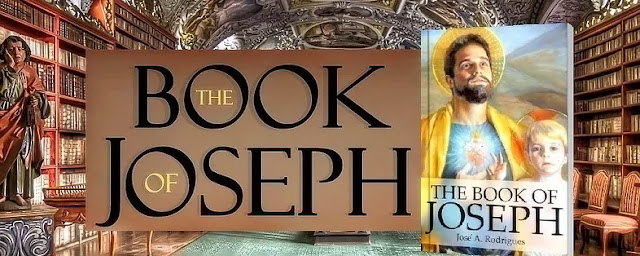
Read more in The Book of Joseph.