Friday, January 18, 2013

Our Lady of Pontmain


The Evening of January 17, 1871

The sky opened… In the barn, the only sound was the conversation between César Barbedette and Jeanne Détais, who had brought some news of the soldiers gleaned at Saint-Ellier where Jeanne had been preparing a corpse for burial. César's son Eugène (12 years old) went out “to check the weather.” It was then that he suddenly noticed up in the sky, above and behind Augustin Guidecoq’s house, a beautiful Lady.


First phase of the apparition

“She has a blue dress with golden stars, gold-ribboned slippers, a golden crown widening towards the top with a red band around it, and a black veil.” The beautiful Lady smiled at him as she did at his brother Joseph (10), who joined him a few moments later, followed by Marie Lebosse (9) and Francoise Richer (11). “Maybe it’s the Virgin Mary” said Victoire, their mother. While the events of the first phase were taking place, other things were happening. Victoire went to fetch Sister Vitaline, who in turn went to fetch Françoise Richer and Jeanne-Marie, two young boarders and Sister Marie-Edouard who went to fetch the parish priest. The villagers ran to the barn and started to pray with Sister Vitaline.

Second phase

The parish priest arrived amongst his parishioners. The crowd was talking, discussing, moving about. “Let us pray” said the parish priest. Sister Marie-Edouard started to say the Rosary. The crowd began the Magnificat.

Then Joseph Babin, a carter by trade, came back from the market at Ernée. You’re right to pray,” he shouted to the crowd, “the Prussians have arrived at Laval.” At the parish priest’s invitation the villagers sang the litanies of the Virgin Mary. They sang ‘Inviolata’. At the invocation ‘O Mater Alma Christi Carissima’, the crowd ended ‘Inviolata’ and sang ‘Salve Regina’. The crowd prayed fervently, in silence. 


A blue oval with four unlit candles appeared around the beautiful Lady. Also, a small red cross was to be seen on her dress at the place where her heart was. The beautiful Lady became sad. A few minutes later, she smiled again and as the prayers became more fervent, she grew slowly in size. The oval also grew and the stars multiplied.

A big white banner unrolled under the feet of the beautiful Lady and then a word appeared letter by letter ‘BUT’.

At that moment the word ‘PRAY’ was written on the banner and then two other words MY CHILDREN.’ Other words appeared, forming a phrase: ‘GOD WILL ANSWER YOU VERY SOON' More followed: MY SON ALLOWS HIS HEART TO BE MOVED WITH COMPASSION Our Lady, for they were all sure that it was her, continued smiling gently.

Third phase

The villagers sang the hymn, “Mother of Hope Whose Name is So Sweet Protect Our Land of France Pray, Pray for Us.”
“Oh, how lovely she is”, the children said again and again. “It’s as if a roller, the same colour as the sky has passed over the words” said the children. Then they sang another hymn, the one they had sung at school that afternoon. The Virgin Mary lifted her hands to the level of her shoulders and moved her fingers in time to the hymn as if to accompany an invisible instrument. Mary was still smiling. The banner and the message disappeared. Then, Our Lady’s face showed great sadness. She seemed to speak but her voice was not heard.

Fourth phase

Seeing the sadness in the Virgin Mary’s face, the people then prayed for forgiveness from Our Lord Jesus “My gentle Jesus At hast the time has come to pardon our penitent hearts. We will never again offend Thy supreme goodness, O gentle Jesus.” The Parce Domine (Spare us, O Lord) served as the response. After this, Our Lady seemed to look sadder. “Look, she’s becoming sad again” said the children. The silent crowd prayed intensely to comfort Our Lady and to gain the favor of her smile once more. A red cross with ‘Jesus Christ’ written in white appeared in front of her. It bore a corpus of the same colour. The Virgin took the cross in both hands and tilted it towards the children. A small star came to light the four candles inside the oval, just as the priest did at church on the Holy Virgin’s altar. The star then took up a position above the Virgin’s head.

Fifth phase

Sister Marie-Edouard started the hymn “Ave Maris Stella.” “My dear friends, said the parish priest, we will all say the evening prayer together.” Everyone kneeled down where they were. When they reached the examination of their conscience, something new happened.

The red crucifix disappeared. A small white cross appeared on each shoulder of the Virgin and she smiled again. A large white veil appeared at the feet of the Virgin. It rose slowly in front of Her, making her disappear from view little by little. It reached the face, then the crown. No more was to be seen.

“Do you still see her?” asked Father Guérin. “No Father, it’s all over.” It was almost nine o’clock in the evening. Everyone went home. Minds were at rest and all fear was gone.

THE PRUSSIAN ARMY RETREATS

The Prussian soldiers, who were steadily advancing, halt their advance across France when the Prussian commander encounters a "Celestial Lady barring the way."

May 10, 1871 – Peace Treaty signed between France and Prussia.

February 2, 1872 – Mgr. Casimir Wicart, bishop of Laval, declares: “We judge that the Immaculate Mary, Mother of God, has truly appeared on January 17, 1871, in the hamlet of Pontmain.”

Pope Pius IX later confirmed the decision of the Episcopal court and granted a Mass and Office proper to Our Lady of Hope of Pontmain.


:+:+:+:+:+:+::+:+:+:+:+:+::+:+:+:

Prayer to Our Lady of Pontmain

Most gracious Virgin Mary, by your apparition at Pontmain, you remind us of the importance of prayer, you fortified in our hearts the hope and trust in God, and you gave us peace. Listen now with favour to our fervent prayers, so that peace may be restored in our hearts, in our families, in our country and in all nations: Peace, the fruit of justice, truth and charity. Inflame in our souls the wish to live fully our Christian faith, without any compromise, in all circumstances of our life. Help us to understand our brethren and to love them in God from the depth of our hearts. Amen.  

:+:+:+:+:+:+::+:+:+:+:+:+::+:+:+:

The 4 Visionaries: Eugene, Joseph, Marie & Francoise


Tuesday, January 15, 2013

The Saints Speak


St. Josemaria Escrivá "St. Joseph protects those who revere him and accompanies them on their journey through this life - just as he protected and accompanied Jesus when he was growing up. As you get to know him, you discover that the holy patriarch is also a master of the interior life - for he teaches us to know Jesus and share our life with him, and to realize that we are part of God's family. St. Joseph can teach us these lessons, because he is an ordinary man, a family man, a worker who earned his living by manual labor - all of which has great significance and is a source of happiness for us."


St. André of Mount Royal 

"When you invoke Saint Joseph, you don't have to speak much. You know your Father in heaven knows what you need; well, so does His friend Saint Joseph. Tell him, “If you were in my place, Saint Joseph, what would you do? Well, pray for this in my behalf.”


St. Alphonsus Liguori "We should, indeed, honor St. Joseph, since the Son of God Himself was graciously pleased to honor him by calling him father. The Holy Scriptures speak of him as the father of Jesus. "His father and mother were marveling at the things spoken concerning Him" (Luke 2:33). Mary also used this name: "in sorrow thy father and I have been seeking thee" (Luke 2:48). If, then, the King of Kings was pleased to raise Joseph to so high a dignity, it is right and obligatory on our part to endeavor to honor him as much as we can."


Sunday, January 6, 2013

St Joseph Treasure: The Holy Cinture

Relic of the Cinture of St Joseph 
Housed in Église Notre-Dame 
(Joinville, Haute-Marne), France


Detail of St Joseph's Cinture
In the 13th century the belt was embroidered with Fleur de Lis emblems and verses from the Litany of St Joseph.

Friday, January 4, 2013

Acknowledge Our Nothingness


St. John tells us that when the Lamb had opened the seventh seal of the mysterious book mentioned in the Apocalypse, there was silence in Heaven, as it were, for half an hour; all the Saints were as if entranced, and could do nothing but admire the infinite majesty of God. So may you also do. Tell St. Joseph that, while others do wonderful things, your part must be to humble yourself, and acknowledge your own nothingness; while they offer their love, you can but offer nothingness and abjection, and acknowledge yourself incapable and unworthy of speaking. Fear not to imitate St. Augustine and other Saints who complained of God to God Himself, in some such terms as these: 


“Thou commandest me to love Thee, O God most worthy of love; why, then, hast Thou given me such a poor and narrow heart? Why art Thou so great and I so little? The object being infinite, should not the heart and love be infinite also?” 


Then you may continue: “Thou hast made St. Joseph so great; Thou inspirest me with the ardent desire to love him, and yet Thou seest how incapable I am of doing anything worthy of Thee or of him. Assist my weakness, I beseech Thee, O Lord! I desire to do what is right, but I have not the power. Give me the power to do more. At any rate, be satisfied to see one who desires more than he is able to perform, who would fain do all that can be done by all men and all Saints, so as to honor Thee in the great things Thou hast done to St. Joseph.”


GO TO JOSEPH AND BE HIS COMPANION IN HUMILITY BEFORE THE LORD. 
ITE AD IOSEPH & BENEDICAMUS DOMINO!


Thursday, January 3, 2013

Mary Mother of God - Homily of Pope Benedict XVI

 January 1, 2013 - Solemnity of Mary Mother of God


Dear Brothers and Sisters,

“May God bless us and make his face to shine upon us.” We proclaimed these words from Psalm 66 after hearing in the first reading the ancient priestly blessing upon the people of the covenant. It is especially significant that at the start of every new year God sheds upon us, his people, the light of his Holy Name, the Name pronounced three times in the solemn form of biblical blessing. Nor is it less significant that to the Word of God – who “became flesh and dwelt among us” (Jn 1:14) as “the true light that enlightens every man” (1:9) – is given, as today’s Gospel tells us, the Name of Jesus eight days after his birth (cf. Lk 2:21).

It is in this Name that we are gathered here today. I cordially greet all present, beginning with the Ambassadors of the Diplomatic Corps accredited to the Holy See. I greet with affection Cardinal Bertone, my Secretary of State, and Cardinal Turkson, with all the officials of the Pontifical Council for Justice and Peace; I am particularly grateful to them for their effort to spread the Message for the World Day of Peace, which this year has as its theme “Blessed are the Peacemakers”.

Although the world is sadly marked by “hotbeds of tension and conflict caused by growing instances of inequality between rich and poor, by the prevalence of a selfish and individualistic mindset which also finds expression in an unregulated financial capitalism,” as well as by various forms of terrorism and crime, I am convinced that “the many different efforts at peacemaking which abound in our world testify to mankind’s innate vocation to peace. In every person the desire for peace is an essential aspiration which coincides in a certain way with the desire for a full, happy and successful human life. In other words, the desire for peace corresponds to a fundamental moral principle, namely, the duty and right to an integral social and communitarian development, which is part of God’s plan for mankind. Man is made for the peace which is God’s gift. All of this led me to draw inspiration for this Message from the words of Jesus Christ: ‘Blessed are the peacemakers, for they will be called children of God’ (Mt 5:9)” (Message, 1). This beatitude “tells us that peace is both a messianic gift and the fruit of human effort … It is peace with God through a life lived according to his will. It is interior peace with oneself, and exterior peace with our neighbours and all creation” (ibid., 2, 3). Indeed, peace is the supreme good to ask as a gift from God and, at the same time, that which is to be built with our every effort.

We may ask ourselves: what is the basis, the origin, the root of peace? How can we experience that peace within ourselves, in spite of problems, darkness and anxieties? The reply is given to us by the readings of today’s liturgy. The biblical texts, especially the one just read from the Gospel of Luke, ask us to contemplate the interior peace of Mary, the Mother of Jesus. During the days in which “she gave birth to her first-born son” (Lk 2:7), many unexpected things occurred: not only the birth of the Son but, even before, the tiring journey from Nazareth to Bethlehem, not finding room at the inn, the search for a chance place to stay for the night; then the song of the angels and the unexpected visit of the shepherds. In all this, however, Mary remains even tempered, she does not get agitated, she is not overcome by events greater than herself; in silence she considers what happens, keeping it in her mind and heart, and pondering it calmly and serenely. This is the interior peace which we ought to have amid the sometimes tumultuous and confusing events of history, events whose meaning we often do not grasp and which disconcert us.

The Gospel passage finishes with a mention of the circumcision of Jesus. According to the Law of Moses, eight days after birth, baby boys were to be circumcised and then given their name. Through his messenger, God himself had said to Mary – as well as to Joseph – that the Name to be given to the child was “Jesus” (cf. Mt 1:21; Lk 1:31); and so it came to be. The Name which God had already chosen, even before the child had been conceived, is now officially conferred upon him at the moment of circumcision. This also changes Mary’s identity once and for all: she becomes “the mother of Jesus”, that is the mother of the Saviour, of Christ, of the Lord. Jesus is not a man like any other, but the Word of God, one of the Divine Persons, the Son of God: therefore the Church has given Mary the title Theotokos or Mother of God.

The first reading reminds us that peace is a gift from God and is linked to the splendour of the face of God, according to the text from the Book of Numbers, which hands down the blessing used by the priests of the People of Israel in their liturgical assemblies. This blessing repeats three times the Holy Name of God, a Name not to be spoken, and each time it is linked to two words indicating an action in favour of man: “The Lord bless you and keep you: the Lord make his face to shine upon you: the Lord lift up his countenance upon you, and give you peace” (6:24-26). So peace is the summit of these six actions of God in our favour, in which he turns towards us the splendour of his face.

For sacred Scripture, contemplating the face of God is the greatest happiness: “You gladden him with the joy of your face” (Ps 21:7). From the contemplation of the face of God are born joy, security and peace. But what does it mean concretely to contemplate the face of the Lord, as understood in the New Testament? It means knowing him directly, in so far as is possible in this life, through Jesus Christ in whom he is revealed. To rejoice in the splendour of God’s face means penetrating the mystery of his Name made known to us in Jesus, understanding something of his interior life and of his will, so that we can live according to his plan of love for humanity. In the second reading, taken from the Letter to the Galatians (4:4-7), Saint Paul says as much as he describes the Spirit who, in our inmost hearts, cries: “Abba! Father!” It is the cry that rises from the contemplation of the true face of God, from the revelation of the mystery of his Name. Jesus declares, “I have manifested thy name to men” (Jn 17:6). God’s Son made man has let us know the Father, he has let us know the hidden face of the Father through his visible human face; by the gift of the Holy Spirit poured into our hearts, he has led us to understand that, in him, we too are children of God, as Saint Paul says in the passage we have just heard: “The proof that you are sons is that God has sent the Spirit of his Son into our hearts: the Spirit that cries, ‘Abba, Father’” (Gal 4:6).

Here, dear brothers and sisters, is the foundation of our peace: the certainty of contemplating in Jesus Christ the splendour of the face of God the Father, of being sons in the Son, and thus of having, on life’s journey, the same security that a child feels in the arms of a loving and all-powerful Father. The splendour of the face of God, shining upon us and granting us peace, is the manifestation of his fatherhood: the Lord turns his face to us, he reveals himself as our Father and grants us peace. Here is the principle of that profound peace – “peace with God” – which is firmly linked to faith and grace, as Saint Paul tells the Christians of Rome (cf. Rom 5:2). Nothing can take this peace from believers, not even the difficulties and sufferings of life. Indeed, sufferings, trials and darkness do not undermine but build up our hope, a hope which does not deceive because “God’s love has been poured into our hearts through the Holy Spirit which has been given to us” (5:5).

May the Virgin Mary, whom today we venerate with the title of Mother of God, help us to contemplate the face of Jesus, the Prince of Peace. May she sustain us and accompany us in this New Year: and may she obtain for us and for the whole world the gift of peace. Amen!


Friday, December 28, 2012

The Holy Innocents


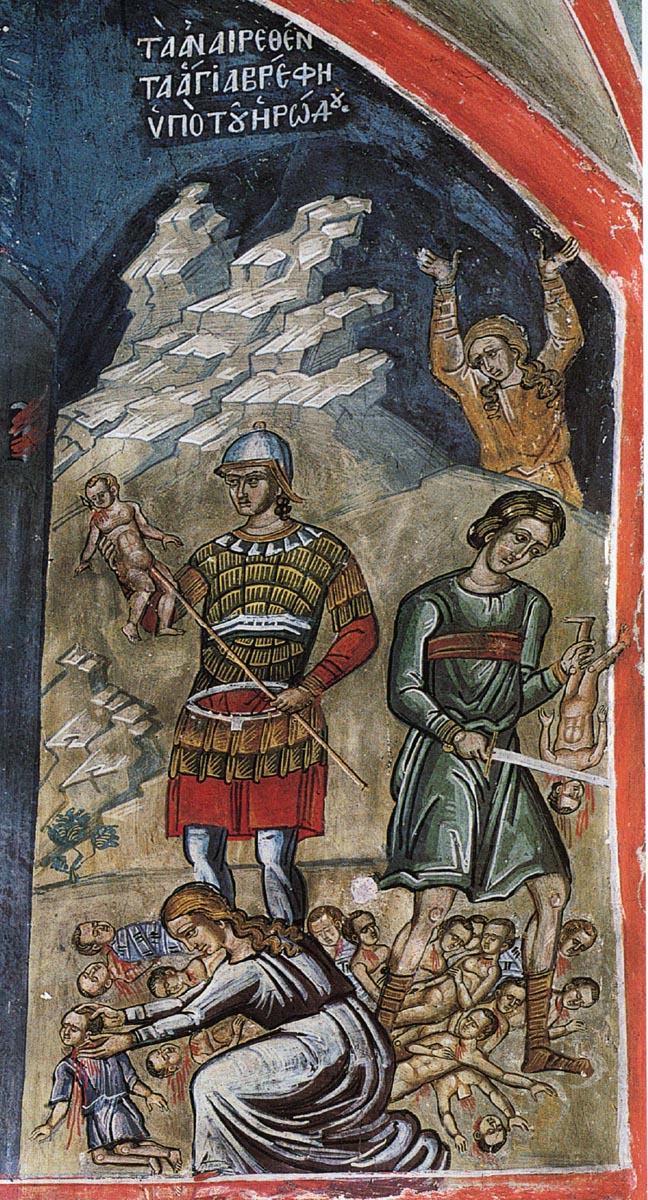
Herod perceiving that he was deluded by the wise men, was exceeding angry; and sending killed all the men children that were in Bethlehem, and in all the borders thereof, from two years old and under, according to the time which he had diligently inquired of the wise men. Then was fulfilled that which was spoken by Jeremias the prophet, saying: A voice in Rama was heard, lamentation and great mourning; Rachel bewailing her children, and would not be comforted, because they are not. - St. Matthew 2:16-18
        In Ramah is heard the sound of moaning, of bitter weeping! Rachel mourns her   
        children, she refuses to be consoled because her children are no more. 
        - Jeremiah 31:15


We rejoice in the glory of Jesus Christ, who conquered the enemy not by force of arms but with a white-robed army of children, and we cry out: The white-robed army of martyrs praises you.

The Holy Innocents gave witness not by words but by their life's blood - give us the strength to be your witnesses before men, both by word's and actions.

They were not ready for battle but you made them fit to win the palm of victory - now that we are prepared for victory, do not let us despair.

You washed the robes of the Innocents in your blood
- cleanse us from all sin.

You rewarded the child martyrs with the first share of your kingdom - do not let us be cast out from the unending heavenly banquet.

You knew persecution and exile as a child - protect all children whose lives are in danger from famine wars and disasters.

O God, whom the Holy Innocents confessed and proclaimed on this day, not by speaking but by dying, grant, we pray, that the faith in you which we confess with our lips may also speak through our manner of life. Through our Lord Jesus Christ, your Son, who lives and reigns with you in the unity of the Holy Spirit, one God, for ever and ever. Amen.

:+: PRO-LIFE PRAYER TO ST JOSEPH :+:
 
Good Saint Joseph, your faithful love protected and nourished the Mother of God and Jesus Christ, her son. Your fatherly care led to maturity He through whom all creation began.

Through your intercession, may God guide and protect all human life from conception to natural death and lead this nation in the ways of truth.

Holy Joseph, Virgin-Father of Christ, pray for the soon to be fathers of the world, and grant all the graces necessary for them to be men of honor and love. + Amen.


__________________________________________